
Emergency Flood Response Melbourne
The water is the easy part. It’s what happens next — in the drainage pit, the lift shaft, the fire stairs and the plasterboard behind the cladding — that turns a flooded car park or lobby into a three-week problem for whoever’s responsible for the building.
We provide 24/7 emergency flood response across Melbourne metro for commercial buildings — basement and podium car parks, foyers and lobbies, corridors and stairwells, lift lobbies and plant rooms. We work directly with facility managers, body corporate and owners corporation managers, and commercial property managers, not individual residential units. Extraction starts when we arrive. Drying starts before we leave.
What Emergency Flood Response Actually Does
Pulling the standing water out of a car park or a lobby is the visible part of the job and the smallest part of it. Water finds the fall in a slab, sits in the low corner of a basement ramp, and wicks up into the plasterboard of a fire stair or a lift lobby wall where nothing you can see will tell you it’s there.
A car park can look drained and a common area can feel dry underfoot, and still be holding enough moisture to grow mould in a riser cupboard, corrode a switchboard, or delaminate the epoxy coating on a car park deck weeks after the event.
So the work runs in two stages. First, extraction — clearing the bulk water out of the car park or common area fast, because every hour it sits in a basement is more risk to plant, switchgear and structure.
Then structural drying — air movers and dehumidifiers positioned in stairwells, lift lobbies and plant rooms to pull the residual moisture out of the building fabric, with moisture readings taken and logged until they come back to normal.
Skipping the second stage is why some car park floods come back as a mould or corrosion job months later.
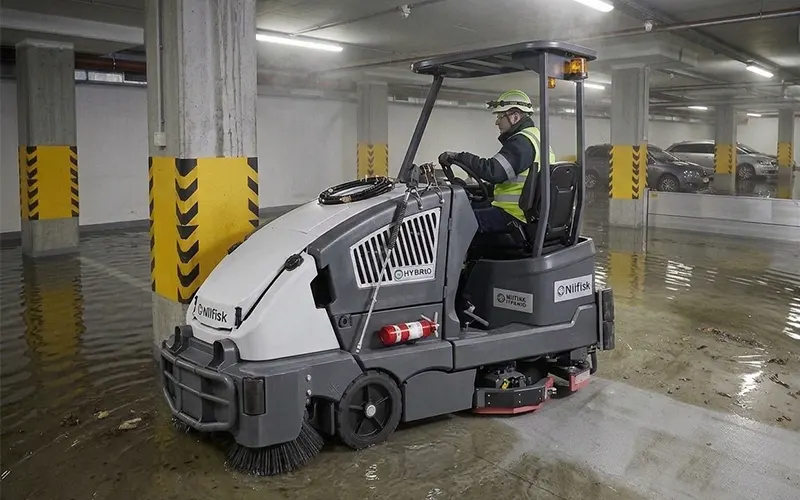
What We Respond To
Stormwater surcharge and blocked or overwhelmed car park drains, sump and lift pit flooding, burst or failed fire services and sprinkler mains in stairwells and corridors, plant room and pump room leaks, roof and podium deck water ingress into foyers and common corridors, sewer surcharge into basement car parks.
Flooding from a neighbouring lot or tenancy into common property, and storm and rain ingress at ground-level entries, loading docks and car park ramps.
Where We Work
Basement and podium car parks, multi-deck commercial car parks and public car parks, office tower foyers and lobbies, retail and shopping centre common areas. Strata and owners corporation common property in commercial and mixed-use buildings, industrial estate common driveways and loading areas, and council and public car park facilities.
That includes carpeted areas: office floors and tenancies, corridors, foyers and meeting rooms. We extract the water from the carpet and underlay, dry it with air movers and dehumidifiers, and once it’s dry we clean it with the same equipment we use for commercial carpet cleaning.
We work with facility managers, body corporate and owners corporation managers, and commercial property managers — this is common property and shared infrastructure, not private residential units.
Why the First 24 Hours Matter
-
Mould: Mould can begin establishing in wet plasterboard, riser cupboards and lift lobby linings within 24 to 48 hours. Once it’s in the wall cavity, you’re no longer cleaning — you’re removing and replacing, and the cost lands with the owners corporation or building owner.
-
What can be saved: Car park line-marking, epoxy coatings, carpet and vinyl in foyers and corridors are often recoverable if they’re extracted and dried fast. Left saturated for a few days, most of it becomes a replacement job, and the bill dwarfs the response cost.
-
Downtime: A closed car park or blocked lobby is a day of frustrated tenants, residents and visitors, and it’s the facility or building manager who fields the complaints. Getting drying underway immediately shortens that window more than anything else you can do.
-
Safety and liability: Standing water near switchboards, pumps, lift equipment and car park ramps is an electrical and slip hazard, and it’s exactly the kind of shared-area incident that turns into a public liability claim against the owners corporation or managing agent.
- Your insurance position: Insurers expect a body corporate or building owner to mitigate loss to common property promptly. Delayed action, and a lack of evidence that action was taken, is a common reason a common property claim is reduced or knocked back.
How We Work
We attend, make the car park or common area safe, and identify the source — there’s no point extracting while water is still coming in from a blocked drain or a failed main.
We isolate where we can, establish what class and category of water we’re dealing with, and take initial moisture readings across the affected common property so we know where the water has actually travelled, not just where it’s pooled in the car park.
Then: bulk extraction with trailer-mounted and portable units, removal of unsalvageable material where it’s beyond saving, cleaning and sanitising of affected surfaces, and placement of air movers and dehumidifiers sized to the car park or common area.
We return to monitor, log readings, and reposition equipment as the site dries, and we tell the facility or body corporate manager when it’s actually dry rather than when the gear comes out.
We document the job as we go — photographs, moisture readings and a record of what was done and when — so the facility manager or owners corporation has evidence for their insurer. Work can be done overnight and around vehicle access, security boom gates and occupied common areas, with signage and exclusion zones to keep residents, tenants and visitors clear.
Emergency call-out — 24 hours a day, seven days a week, including public holidays.
Drying and monitoring — equipment on site for as long as the readings say it needs to be, with scheduled return visits.
Post-event cleaning — carpet and hard floor cleaning, car park pressure washing and sanitising once the structure is dry.
What to Do Before We Arrive
If it’s safe to do so:
Keep people clear — cordon off the flooded area and any ramps or stairs leading into it. Wet concrete and epoxy are slippery, and standing water can hide open drains and debris. If sewage is involved, keep everyone out.
Stay away from electrics — don’t walk through water near switchboards, pumps or lift equipment. If water has reached electrical equipment, have the power isolated by an electrician or your building maintenance contractor.
Stop the source if you can — close the isolation valve on a burst pipe, or call your plumber or fire services contractor for a failed sprinkler or fire main.
Take photos and video — before anything is moved, record where the water is, how deep it is and what’s been affected. Your insurer will ask for it.
Move what you can — vehicles, stock and furniture out of the water’s path, if it’s safe to do so.
Then call us on 1300 398 724 and tell us the source, the area affected, and whether the water is clean, stormwater or sewage, so we arrive with the right equipment.
FAQs
Do you work directly with facility managers and owners corporations?
Most of our car park and common area flood work is instructed by a facility manager, body corporate or owners corporation manager, or a commercial property manager, and we’re used to working within their reporting and approval process rather than dealing with individual residents or tenants directly.
Can you respond without closing the whole car park?
Often, yes. Where the flooding is contained to one level, bay or drainage line, we can isolate and work that area while the rest of the car park stays accessible. Full closure is usually only needed where the water affects switchrooms, lift equipment or the only vehicle entry and exit.
How quickly can you get to site?
We run a 24/7 emergency line on 1300 398 724 and aim to be on site within a few hours anywhere in Melbourne metro. Call and we’ll give you a straight answer on arrival time rather than a promise we can’t keep.
How long does drying take?
Most car park and common area jobs run three to five days with equipment on site, but it depends on how much water there was, what materials are affected and how well the space ventilates. Concrete and plasterboard hold moisture longer than people expect. We take readings rather than guess, and the equipment stays until the readings are right.
Do you deal with sewage or stormwater surcharge in basement car parks?
Yes. Contaminated water is handled differently to clean water — more material is discarded rather than dried, the area is sanitised, and waste is disposed of appropriately. Tell us what the source is when you call so we arrive with the right equipment and PPE for a confined basement space.
Do you work with insurance claims?
We’re not an insurance assessor and we don’t manage claims, but we document the job thoroughly — photographs, moisture readings, and a written record of the work and timeline. That’s the evidence your insurer or broker will ask for, and we can invoice the owners corporation, facility manager or your nominated party directly.
Do you attend after hours and on weekends?
Yes. Car park and common property flooding doesn’t keep business hours, and neither do we. We operate 24/7 across Melbourne metro, including weekends and public holidays.
How much does emergency flood response cost?
It depends on how much water there is, what kind of water it is (clean, stormwater or sewage), the area and materials affected, and how long drying equipment needs to stay on site. Contaminated water costs more because more material has to be removed and the area sanitised. We assess the site, explain the scope before the main work starts, and document everything for your insurer or owners corporation.
Services
Let's Talk
Enter your details. We’ll call you back to discuss your needs.